Nearby Cycles [nearby]
Nearby Cycles [nearby]
This note mainly follows Prof. Zheng’s MCM talk.
The Milnor fibration
Let $f\colon (\mathbb{C}^{n+1},0) \to (\mathbb{C},0)$ be a germ of holomorphic function having an isolated critical point at $0$.
Theorem (Milnor 1967). For $0<\eta \ll \varepsilon \ll 1$, $$ f\colon B_\varepsilon\cap f^{-1}(D_\eta) \to D_\eta $$ induces a fibration over $D_\eta \setminus \{0\}$, where $B_\varepsilon$ and $D_\eta$ are respectively the ball and the disk centered at $0$.
This is called the milnor fibration (see there for more motivation).
The fiber $M_t = f^{-1}(t) \cap B_\varepsilon$ is homotopy equivalent to a bouquet of $\mu$ $S^n$’s, where $\mu$ is the Milnor number $$ \mu = \dim_\mathbb{C} \mathbb{C}\{z_0,\cdots,z_n\}/(\partial_1 f,\cdots,\partial_n f). $$
Examples.
- $f(x,y) = x^3 - y^2$. The Milnor fiber $M_t$ is a punctured torus (its boundary being a trefoil knot), homotopy equivalent to $S^1 \vee S^1$. The Milnor number is $\dim_\mathbb{C} \{x,y\}/(3x^2,2y) = 2$.
Let $\Phi^i$ denote the reduced cohomology of the fiber $M_t$, acted on by a monodromy operator $T\in\operatorname{Aut}(\Phi^i)$ as $t$ turns around $0$.
Conjecture (Milnor). The eigenvalues of $T$ are roots of unity.
Nearby cycles over one-dimensional bases
Let $S$ be the spectrum of a (strictly local) Henselian DVR. It will be the analog of a disk. More precisely, there is a dictionary between complex analytic and étale settings:
| Complex analytic | Etale |
|---|---|
| disk $D_\eta$ | base $S$ |
| center $0\in D_\eta$ | closed point $s\in S$ |
| punctured disk $D_\eta\setminus\{0\}$ | generic point $\eta\in S$ |
| parameter $t\in D\setminus\{0\}$ | separable closure $\bar\eta$ |
| fundamental group $\pi_1(D\setminus\{0\},t)$ | inertia group $\operatorname{Gal}(\bar\eta / \eta)$ |
| local systems on $D_\eta\setminus\{0\}$ | sheaves on $\eta_{\text{\'et}}$ |
The complex analytic setting
In the complex analytic setting, following Dimca, we have a analytic function $f\colon X\to\mathbb{C}$. Denote $X_t = f^{-1}(t)$. Consider the pullback diagram

where $T = f^{-1}(D_\varepsilon)$ is a tube near $X_0$, and $f$ now denotes the Milnor fibration. The sheaf of nearby cycles of $F\in D^b(X)$ is defined by $$ \psi_f F := i^* \, R(j\hat\pi)_* \, (j\hat\pi)^* F \in D^b(X_0). $$
We remark that $E$ can be regarded as the universal/canonical fiber of the Milnor fibration, and the map $j\hat\pi$ is a canonical model (i.e. independent of the choice of a specific fiber) for the inclusion of a fiber $X_t$ into the tube $T$.
There is a monodromy “deck transformation” $h\colon E\to E$ coming from the action of the generator of $\mathbb{Z} = \pi_1(D_\varepsilon^*)$.
The following proposition explains the name of nearby cycles.
Proposition. For $x\in X_0$, the cohomology of the sheaf of nearby cycles $$ \mathcal H^k(\psi_f F)_x \simeq H^k(F_x,F) $$ recovers the cohomology of the local Milnor fiber $F_x = B_\epsilon (x) \cap X_t$ ($0<|t|\ll \varepsilon$), the monodromy morphisms matching as well.
Example. Let $F=\mathbb{C}_X$; then $\dim H^n(F_x,F)=\mu$ is the Milnor number.
Consider the unit of the adjunction $$ F \to R(j\hat\pi)_* \, (j\hat\pi)^* F $$ giving the comparison morphism $$ i^* F \to \psi_f F. $$ Define the sheaf of vanishing cycles $\varphi_f F \in D^b(X_0)$ to be the third term in the fiber / cofiber sequence $$ i^*F \to \psi_f F \to \varphi_f F $$ with an induced monodromy operator.
The étale setting
In the étale setting, we consider a morphism of schemes $X\to S$ and the base-change diagram
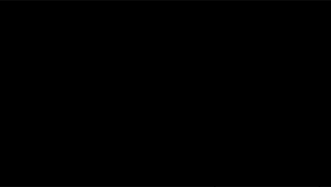
Let $\Lambda = \mathbb{Z}/m\mathbb{Z}$ for $m$ invertible on $S$. We work with sheaves of $\Lambda$-modules on étale topoi.
Following Zheng, for $K\in D(X_\eta)$ define $$ R\Psi K = i^* \, Rj_* (K|_{X_{\bar\eta}}) \in D(X_s). $$
For $K\in D(X)$, define $\Phi K\in D(X_s)$ by the fiber / cofiber sequence $$ K|_{X_s} \to R\Psi (K|_{X_\eta}) \to \Phi K. $$
For a geometric point $x\to X_s$ we have a fiber / cofiber sequence $$ K_x \to (R\Psi K)_x \to (\Phi K)_x. $$
Nearby cycles over general bases
Oriented products of topoi
This part follows Zheng which cites ILO, Exposé XI by Illusie.
Given morphisms of topoi $f\colon X\to S$ and $g\colon Y\to S$, the oriented product (also called the lax pullback) is a topos $X\operatorname{\overset{\leftarrow}{\times}}_SY$ together with a diagram
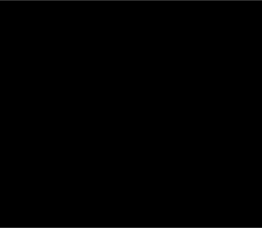
universal for these data.
Definition. The vanishing topos of an $S$-scheme $X\to S$ is the oriented product $X \operatorname{\overset{\leftarrow}{\times}}_S S$, where we regard schemes as topoi by the construction of étale topoi.
A site presentation of the oriented product $X\operatorname{\overset{\leftarrow}{\times}}_SY$ is as follows.
- The objects are commutative diagrams

- The following are declared covering families:
- coverings of $U$,
- coverings of $V$,
- and the following kind of morphisms.

An important way to think of this topos is by considering its points. Before doing this, let me recall the geometric picture. The Henselization of a scheme at a (geometric) point $s\to S$, denoted $S_{(s)}$, is the limit of all étale neighborhoods of $s$, a small neighborhood whose étale topos is a local topos, meaning that the global section is isomorphic to just a stalk.
Theorem (SGA4 VIII.7.9). The category $\operatorname{Hom}_{\mathsf{Topos}}(\mathrm{pt},X_{\text{\'et}})$ of points of the étale topos of a scheme $X$ is equivalent to the category of geometric points of $X$ and specializations.
From the above theorem, the points of $X \operatorname{\overset{\leftarrow}{\times}}_S S$ can be regarded as triples $(x,t,\mathrm{sp})$, where
- $x\to X$ is a geometric point of $X$,
- $t\to S$ is a geometric point of $S$,
- and $\mathrm{sp}\colon t \to S_{(f(x))}$ is a specialization, which is equivalent to an $S$-morphism $S_{(t)}\to S_{(f(x))}$ (SGA4 VIII.7.4).
Example (ILO XI.1.12). When $f\colon X\to Y$ is a closed subscheme, $X \operatorname{\overset{\leftarrow}{\times}}_Y Y$ plays the role of a tubular neighborhood of $X$ in $Y$.
The Milnor fiber at this point is defined as $$ X_{(x)} \times_{S_{(f(x))}} t, $$ and the Milnor tube is $$ X_{(x)} \times_{S_{f(x)}} S_{(t)}. $$
Definition. Given an $S$-scheme $f\colon X\to S$, the geometric morphism $\Psi_f \colon X\to X\operatorname{\overset{\leftarrow}{\times}}_S S$ is determined by the diagram

and the universal property of oriented products.
We then define $\Phi_f K$ by the following fiber / cofiber sequence in $D(X \operatorname{\overset{\leftarrow}{\times}}_S S)$: $$ p^*K \to R\Psi_f K \to \Phi_f K. $$
Example. For $S$ the spectrum of a strictly local DVR, $$ X \operatorname{\overset{\leftarrow}{\times}}_S S = X_\eta \cup (X_s \times\eta) \cup X_s. $$ Then the restriction of $R\Psi_f K$ on the three shreds are respectively $$ K|_{X_\eta}, \,R\Psi(K|_{X_\eta}),\,K|_{X_s}. $$
Proposition. The functor $R\Psi$ recovers cohomologies of the Milnor tube: $$ (R\Psi F)_{(x,t)} \simeq R\Gamma(X_{(x)}\times_{S_{f(x)}}S_{(t)},F). $$ Moreover, $R\Psi F$ is equipped with a Galois action.