参考文献: Factorization homology I: higher categories
合集: 流形与高阶范畴
上一集: 分层空间与范畴
下一集: 缠结假设 (1 维)
1 关于条纹层 (striation sheaves) 的回顾
本节是对 AFR 的回顾, 参见相关笔记.
1.1 分层空间
本文的 “分层空间” 特指一类具有良好微分拓扑行为的分层空间, 它是光滑流形在分层空间理论中的推广; 它的每一层为光滑流形, 层与层相接处还有额外的相容性. 我们不详细解释定义, 只陈述其性质:
- 分层空间被形如 $\mathbb{R}^i \times \mathbb{R}_{\geq 0}^j \times C(Z)$ 的基本开集 (又叫奇点类型) 覆盖, 其中 $Z$ 是更低维的分层空间;
- 分层空间的态射 $f\colon C(X)\to C(Y)$ (锥点为单独一层, 锥点打到锥点) 给出链环之间的 “切映射” $Df \colon X \to Y$.
- 事实上 (后面将介绍), 分层空间的 $(\infty,1)$-范畴 $\mathsf{Strat}$ 通过出路范畴函子 $\mathsf{Exit}\colon \mathsf{Strat}\to\mathsf{Cat}$ 全忠实地嵌入范畴的范畴, 从而分层空间的态射 $X\to Y$ 等同于其出路范畴之间的函子 $\mathsf{Exit}(X)\to\mathsf{Exit}(Y)$.
光滑流形的 $(1,1)$-范畴是分层空间范畴的全子范畴
$$
\mathsf{Mfd}\hookrightarrow\mathsf{Strat}.
$$
分层空间有几类重要的态射:
- 开嵌入来自拓扑空间的开嵌入;
- 加细在拓扑空间上为同胚, 只是可能加入新的分层;
- 纤维丛要求在某个开覆盖的每片上为乘积;
- 可构造丛 (constructible bundle) 是一个归纳定义的概念, 对于态射 $f\colon X\to Y$, 要求对 $Y$ 的每一层 $Y_q$,
- $f^{-1}Y_q \to Y_q$ 为纤维丛,
- $\operatorname{Link}_{f^{-1}Y_q}(X)\to f^{-1}Y_q\times_{Y_q}\operatorname{Link}(Y)$ 为可构造丛.
- 紧合可构造丛是满足紧集的逆像为紧集的可构造丛.
回忆, 单纯形可通过至少两种不同方式实现为分层空间, 即有两个函子
$$
\Delta\to \mathsf{Strat},
$$
关于这些函子, 各文献记号不一. 本文约定如下记号:
- $\Delta^n$ 表示带标准分层结构的迭代闭锥, $\Delta^n := \overline{C}(\Delta^{n-1})$, 对任意 $0\leq i\leq n$, $\Delta^n$ 有且仅有一个 $i$ 维分层;
- $\Delta^n_{\mathrm{ext}}$ 表示带平凡分层结构, 且无限延伸的 $n$ 维 “扩展单形” $\{x_0 + \cdots + x_n = 1\}$.
分层空间的范畴 $\mathsf{Strat}$ 一开始是 $(1,1)$-范畴, 但实际上它可充实于生象, 即构成 $(\infty,1)$-范畴. 它可由如下的 Kan 复形充实结构 $\underline{\operatorname{Hom}}_{\mathsf{Strat}}$ 定义:
$$
\underline{\operatorname{Hom}}_{\mathsf{Strat}}(X,Y)[n] :=\operatorname{Hom}_{\mathsf{Strat}_{/\Delta^n_{\mathrm{ext}}}}(X\times\Delta^n_{\mathrm{ext}}, Y\times\Delta^n_{\mathrm{ext}}).
$$
它还有一个性质: $(\infty,1)$-范畴版本的 $\mathsf{Strat}$ 是 $(1,1)$-范畴版本关于所有投影 $X\times\mathbb{R}\to X$ 的局部化. 后文中我们将永远使用 $(\infty,1)$-范畴版本 (用 $\operatorname{Hom}_{\mathsf{Strat}}$ 表示态射生象), 所以无需区分记号.
1.2 出路范畴
命题.
“出路范畴” 函子
$$
\mathsf{Exit}\colon \mathsf{Strat}\hookrightarrow \mathsf{sAni},\, X\mapsto ([n]\mapsto\operatorname{Hom}_{\mathsf{Strat}}(\Delta^n, X))
$$
是全忠实函子, 且其像落在范畴 (即完备 Segal 生象) 的范畴 $\mathsf{Cat}\hookrightarrow\mathsf{sAni}$ 中.
1.3 条纹层
回忆 $\mathsf{Strat}$ 有如下的余极限, 称为特殊余极限:
- 开覆盖;
- 爆破 (又叫锥局部性, 详见上一集);
- 迭代锥 (又叫接续性, 详见上一集);
- 泛等性
$$
\begin{array}{ccc}
\Delta^{ \{0 < 2\}} + \Delta^{ \{1 < 3\}} & \rightarrow & \Delta^{\{0 < 1 < 2 < 3\}} \\
\downarrow & & \downarrow \\
{*} + {*} & \rightarrow & {*}.
\end{array}
$$
由出路范畴函子 $\mathsf{Exit}\colon \mathsf{Strat} \hookrightarrow \mathsf{Cat}$, 我们又可将范畴变为 $\mathsf{Strat}$ 上的预层. 我们甚至可以写出判断这样一个预层何时来自范畴的条件.
定义. 条纹层 (striation sheaf) 的范畴
$$
\mathsf{Stri}\hookrightarrow \mathsf{Psh}(\mathsf{Strat})
$$
是 $\mathsf{Strat}$ 上将前述 “特殊余极限” 变为极限图的预层构成的全子范畴.
当然, 条纹层不构成意象; 事实上这个 “层条件” 不构成 Grothendieck 拓扑. (毕竟 $\mathsf{Stri} \simeq \mathsf{Cat}$ 而 $\mathsf{Cat}$ 不是 $(\infty,1)$-意象.)
定理. 出路范畴函子 $\mathsf{Exit}\colon \mathsf{Strat}\to \mathsf{Cat}$ 对应的脉函子 $\mathsf{Cat}\to\mathsf{Psh}(\mathsf{Strat})$ 将 $\mathsf{Cat}$ 等同于全子范畴 $\mathsf{Stri}$.
下面我们将定义几个 $\mathsf{Strat}$ 上的条纹层, 可视为分层空间上几种结构的分类空间. 在此之前引入一种一般性的构造.
定义. 我们定义如下条纹层, 从而定义相应的范畴:
- $\mathsf{Bun}$ 分类可构造丛;
- $\mathsf{cBun}$ 分类紧合可构造丛;
- $\mathsf{Exit}$ 分类带一个截面的可构造丛.
直观上, 两个范畴 $\mathsf{Bun}$, $\mathsf{Exit}$ 可描述如下:
- $\mathsf{Bun}$ 的对象是分层空间, 态射是 $\Delta^1$ 上的可构造丛 (注意, 态射不仅是分层空间之间的态射, 还包含了 “配边”, 更一般地, $\mathsf{Bun}$ 的 $K$-点是分层空间的 $K$ 参数化的 “配边”;
- $\mathsf{Exit}$ 的对象是分层空间带一个指定的点, 态射是 $\Delta^1$ 上的可构造丛带一个截面;
命题. 每个可构造丛 $X\to K$ 给出函子 $\mathsf{Exit}(K) \to\mathsf{Bun}$ 以及 $\mathsf{Exit}(X)\to\mathsf{Exit}$; 有拉回图
$$
\begin{array}{ccc}
\mathsf{Exit}(X) & \rightarrow & \mathsf{Exit} \\
\downarrow & & \downarrow \\
\mathsf{Exit}(K) & \rightarrow & \mathsf{Bun}.
\end{array}
$$
特别地, $K = {*}$ 时, 我们知道 $\mathsf{Exit}(X)$ 就是 $\mathsf{Exit}\to\mathsf{Bun}$ 在对象 $X\in\mathsf{Bun}$ 处的纤维.
1.4 几类态射
我们定义 $\mathsf{Bun}$ 中的几类特殊的态射.
下列是两种构造 $\mathsf{Bun}$ 中的态射 (即 $\Delta^1$ 上的可构造丛) 的方式:
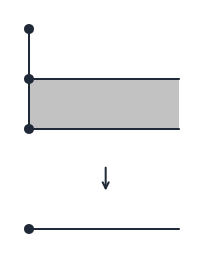
一是紧合可构造映射的反向映射柱 (reverse mapping cylinder)
$$
\mathsf{Cylr}(X\to Y) := Y \sqcup_{X\times\{0\}} (X\times [0,1]);
$$
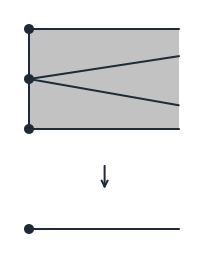
二是开映射柱 (open mapping cylinder)
$$
\mathsf{Cylo}(X\to Y) := (X \times [0,1])\sqcup_{X\times\left(0,1\right]}Y\times\left(0,1\right];
$$
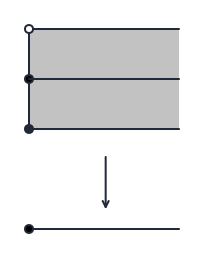
- 开嵌入是底层拓扑空间上为开嵌入, 且继承子空间分层结构的映射的开映射柱;
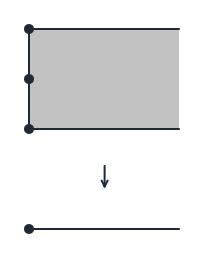
- 细化映射是底层拓扑空间上为同胚, 且每一层限制为到像的同构的映射的开映射柱;
最后我们定义
- 活性映射是最小的包含创生, 细化与开嵌入的映射类.
这里 “惰性” 和 “活性” 的概念与代数模式有关, 且与流形图的笔记)中的用法非常相似.
命题. 惰性映射与活性映射构成 $\mathsf{Bun}$ 的分解系统; 任何映射都能分解为先一个惰性映射后一个活性映射. (这里的分解顺序与我们在代数模式页面的约定相反, 但与 Chu–Haugseng 相同; 这只是由于范畴 $\mathsf{Bun}$ 中态射方向的约定.)
2 切结构
2.1 切丛
记 $\mathsf{Vect}^{\mathrm{inj}}$ 为实线性空间, 线性单射以及线性单射中的同伦构成的 $(\infty,1)$-范畴. 其中 $\operatorname{Hom}(\mathbb{R}^i,\mathbb{R}^j)\simeq\mathrm{O}(j) / \mathrm{O}(j-i)$.
每个分层空间都给出一个函子
$$
T_X\colon \mathsf{Exit}(X) \to \mathsf{Vect}^{\mathrm{inj}},
$$
称为其切丛. 事实上该构造关于 $X$ 有很好的函子性, 以至于可以写成 “万有出路范畴” 出发的函子
$$
T\colon \mathsf{Exit} \to \mathsf{Vect}^{\mathrm{inj}}.
$$
2.2 标架
定义. 一种切结构是一个函子
$$
\mathcal B \to \mathsf{Vect}^{\mathrm{inj}}.
$$
我们常将其简记为 $\mathcal B$.
定义. 设 $X$ 为分层空间, $\mathcal B$ 为切结构. 定义 $X$ 上的 $\mathcal B$-结构为提升
$$
\begin{array}{ccc}
& & \mathcal B \\
& \nearrow & \downarrow \\
\mathsf{Exit}(X) & \underset{T_X}{\rightarrow} & \mathsf{Vect}^{\mathrm{inj}}.
\end{array}
$$
定义 $\mathcal B$-分层空间的范畴为
$$
\mathsf{Bun}^{\mathcal B} = \pi_* T^* \mathcal B \to \mathsf{Bun},
$$
其中 $\pi_*$ 表示沿 $\pi \colon \mathsf{Exit}\to\mathsf{Bun}$ 的依值积.
定义. 变标架切结构 (vari-framing) 是函子
$$
\mathrm{vfr}\colon \mathbb{N}\to\mathsf{Vect}^{\mathrm{inj}},\,i\mapsto\mathbb{R}^i.
$$
这里 “变” (vari-) 意指跨分层时切丛维数改变.
另外, 对于自然数 $n$, 定义 $n$-变标架切结构为其限制
$$
\mathrm{vfr}_n\colon [n]\to\mathsf{Vect}^{\mathrm{inj}},\,i\mapsto\mathbb{R}^i.
$$
例. 考虑闭圆盘 $D^n$, 其边界划分为两个 $n-1$ 维圆盘, 递归向下. 它上面有一个 $n$-变标架切结构. 这可以理解为从 $*$ 反复作纬悬 $X\mapsto SX$ 得到.
定义. 变标架分层 $n$-流形的范畴为
$$
\mathsf{Mfd}_n^{\mathrm{vfr}} := \mathsf{Bun}^{\mathrm{vfr}_n}.
$$
稳固切结构
定义. 稳固切结构 (solid tangential structure) 是预层 $(\mathsf{Vect}^{\mathrm{inj}})^{\mathrm{op}} \to \mathsf{Ani}$ (的反直化) 给出的切结构.
我们知道不是所有函子 $\mathcal B\to\mathsf{Vect}^{\mathrm{inj}}$ 都来自预层的反直化, 不是所有切结构都是稳固切结构. 但一般的切结构可以自由地变为一个稳固切结构.
以下仅考虑 $\mathcal B$ 为生象的情形. 定义 $\mathrm{s}(\mathcal B)\colon (\mathsf{Vect}^{\mathrm{inj}})^{\mathrm{op}} \to \mathsf{Ani}$,
$$
\mathrm{s}(\mathcal B) (V) = \{V\hookrightarrow p(b)\},
$$
其中 $p$ 表示函子 $\mathcal B\to\mathsf{Vect}^{\mathrm{inj}}$, $b\in\mathcal B$.
上式也可以写成
$$
\mathrm{s}(\mathcal B) (V) = \{(V\hookrightarrow W, b\in p^{-1}(W))\}.
$$
例. 定向结构 $\mathrm{or} := (\bigsqcup_n \mathbf{B}\mathrm{SO}(n) \to \mathsf{Vect}^{\simeq}\to\mathsf{Vect}^{\mathrm{inj}})$ 给出的稳固切结构为 $\mathrm{sor}\colon (\mathsf{Vect}^{\mathrm{inj}})^{\mathrm{op}}\to\mathsf{Ani}$,
$$
\mathrm{sor}(V) = \{(V\hookrightarrow W, \alpha\in\mathrm{or}(W))\}.
$$
例 (流形结构). 对固定的 $n$, 函子 $\mathbf{B}\mathrm{O}(n)\to\mathsf{Vect}^{\mathrm{inj}}$ 给出的稳固切结构称为 $n$-流形结构 $\mathrm{mfd}_n\colon (\mathsf{Vect}^{\mathrm{inj}})^{\mathrm{op}}\to\mathsf{Ani}$:
$$
\mathrm{mfd}_n (V) = \{(V\hookrightarrow W, \operatorname{dim}W = n)\}.
$$
若分层空间 $X$ 带有 $n$-流形结构, 则其各层维数不超过 $n$, 并且存在 $X$ 上的 $n$ 阶向量丛 $\eta$ (来自函子 $\mathsf{Exit}(X)\to\mathbf{B}\mathrm{O}(n)$) 与可构造丛的嵌入
$$
T_X\hookrightarrow\eta;
$$
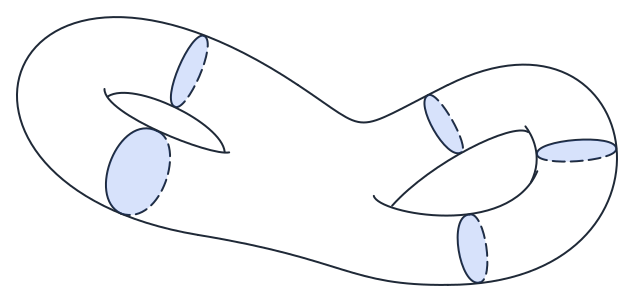
直观上 $X$ 可以 “微小加厚” 成 $n$ 维流形. 例如下图中的十字形具有 $2$-流形结构.

称带有 $n$-流形结构的分层空间为分层 $n$-流形 (stratified $n$-manifold).
例 (稳固标架结构). 对固定的 $n$, 函子 $1\overset{\mathbb R^n}{\to}\mathsf{Vect}^{\mathrm{inj}}$ 给出的稳固切结构称为稳固 $n$-标架 (solid $n$-framing) $\mathrm{sfr}_n\colon (\mathsf{Vect}^{\mathrm{inj}})^{\mathrm{op}}\to\mathsf{Ani}$:
$$
\mathrm{sfr}_n (V) = \{V\hookrightarrow \mathbb R^n\}.
$$
对于给定的分层 $n$-流形 $(X,T_X\hookrightarrow\eta)$, 其上的稳固 $n$-标架结构相当于 $\eta$ 的平凡化. 相比之下, 其上的变标架要求的是态射 $T_X\hookrightarrow\eta$ 的平凡化 (也即两个函子 $\mathsf{Exit}(X)\to\mathsf{Ar}(\mathsf{Vect}^{\mathrm{inj}})$ 自然同构), 这是一个更强的要求.
一般而言, 稳固 $n$-标架既不能确保存在变标架, 也不能确保其唯一.
稳固切结构与变标架的关系
3 圆盘
3.5
定义全子范畴
$$
\mathsf{cDisk}_n^{\mathrm{vfr}}\hookrightarrow\mathsf{cMfd}_n^{\mathrm{vfr}},
$$
其对象简单地说就是由有限个圆盘粘起来的图案. 具体地说它的对象类是包含如下对象的最小类:
- $\varnothing$, $*$;
- 沿一个公共闭子分层的粘合;
- todo
例.
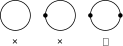
- $S^1$ 带有平凡分层结构, 不属于 $\mathsf{cDisk}_1^{\mathrm{vfr}}$;
- $S^1$ 带有一个 $0$ 维分层点和一个 $1$ 维分层 $S^1\setminus\{*\}$, 仍然不属于 $\mathsf{cDisk}_1^{\mathrm{vfr}}$;
- $S^1$ 带有两个 $0$ 维分层点和两个 $1$ 维圆弧, 就属于 $\mathsf{cDisk}_1^{\mathrm{vfr}}$.
例.
- $S^2$ 带有平凡分层结构时, 甚至不属于 $\mathsf{cMfd}_2^{\mathrm{vfr}}$ ($TS^2$ 不是平凡丛);
- $S^2$ 带有一个 $0$ 维分层点和一个 $2$ 维分层 $S^2\setminus\{*\}$, 属于 $\mathsf{cMfd}_2^{\mathrm{vfr}}$ 但不属于 $\mathsf{cDisk}_2^{\mathrm{vfr}}$;
3.8 胞腔几何实现
定义函子
$$
\langle - \rangle \colon \Delta^{\mathrm{op}} \to \mathsf{cDisk}_1^{\mathrm{vfr}},
$$
- $\langle [0] \rangle$ 是点 $D^0$,
- $\langle [1] \rangle$ 是线段 $D^1$,
- $\Delta$ 中的惰性映射 (区间含入) 对应惰性映射,
- $\Delta$ 中的活性映射 (保端点映射) 对应活性映射.
然后归纳地定义胞腔几何实现 (AFR 定义 3.53)
$$
\langle - \rangle \colon \Theta_n^{\mathrm{op}} \to \mathsf{cDisk}_n^{\mathrm{vfr}}.
$$
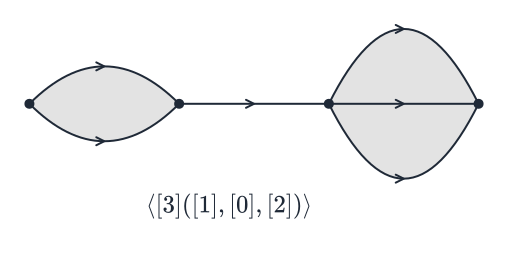
注意这个函子不是全忠实的, 也不是本质满的.
4 分解同调
4.2
引理. 函子 $\Theta_n^{\mathrm{op}} \to \mathsf{cDisk}_n^{\mathrm{vfr}}$ 的脉
$$
\mathfrak C \colon (\mathsf{cDisk}_n^{\mathrm{vfr}})^{\mathrm{op}} \to \widehat {\Theta}_n
$$
落在全子范畴 $\mathsf{Cat}_{(\infty,n)}$ 中.
4.3
定义 (4.13). 分解同调为函子
$$
\int\colon \mathsf{Cat}_{(\infty ,n)}\to\mathsf{Fun}(\mathsf{cDisk}_n^{\mathrm{vfr}},\mathsf{Ani})\hookrightarrow\mathsf{Fun}(\mathsf{cMfd}_n^{\mathrm{vfr}},\mathsf{Ani}),
$$
其中
- 第一步为沿 $\Theta_n^{\mathrm{op}}\hookrightarrow \mathsf{cDisk}_n^{\mathrm{vfr}}$ 的右 Kan 扩张;
- 第二步为沿 $\mathsf{cDisk}_n^{\mathrm{vfr}} \hookrightarrow \mathsf{cMfd}_n^{\mathrm{vfr}}$ 的左 Kan 扩张.
具体地, 对于 $(\infty,n)$-范畴 $\mathcal C$ 与标架分层流形 $M$, 分解同调可写为
$$
\int_M \mathcal C = \operatorname{colim}_{D\to M}\operatorname{Hom}_{\mathsf{Cat}_{(\infty,n)}}(\mathfrak C(D),\mathcal C).
$$