Tangle Hypothesis [pre-tangle]
Tangle Hypothesis [pre-tangle]
In this page I collect material for my final presentation of professor Reshetikhin’s course “Knots and 3-manifolds” in 2026 fall. I try to list all essential ideas to the story. Due to the time limit, some content may not appear in the actual presentation.
This page contains no AI-generated content.
The category of tangles
Given a framed manifold $V$ and a natural number $k$, we may define a $k$-category $\mathsf{Tang}_k^V$. It can be roughly described as follows.
- An object $X$ of $\mathsf{Tang}_k^V$ is a framed compact $0$-dimensional submanifold of $V$.
- A $1$-morphism $X\to Y$ is a framed $1$-dimensional submanifold of $V\times [0,1]$ that intersects $V\times \{0\}$ at $X$, and $V\times \{1\}$ at $Y$.
- For $i \leq k$, an $i$-morphism between $(i-1)$-morphisms is an $i$-dimensional framed submanifold of $V\times [0,1]^i$ that intersects the boundary at prescribed places (and satisfies some transversality conditions).
The following picture shows a $1$-morphism of $\mathsf{Tang}_1^{\mathbb{R}^2}$.

In the case of $\mathsf{Tang}_1^{\mathbb{R}^2}$, the framing on an object can be regarded as the choice of a $+ / -$ sign for each point.
The case $V = \mathbb{R}^n$ is particularly important because of the following fact.
Fact. $\mathsf{Tang}_k^{\mathbb{R}^n}$ is a rigid $\mathbb E_n$-monoidal $k$-category.
$\mathbb E_n$-structure
We now explain the concept of an $\mathbb E_n$-structure. It is an algebraic structure where elements can be “tensored together along $\mathbb{R}^n$”.
- An $\mathbb E_1$-mondoial category is just a monoidal category: objects can be tensored together along a line (so they must be linearly ordered).
- An $\mathbb E_2$-monoidal category is a braided monoidal category: objects can be tensored along a plane (so one object can travel around another in loops, resulting in nontrivial automorphisms).
- An $\mathbb E_n$-monoidal category ($2 < n < \infty$) has more structure than a braiding, but is still not symmetric in general because of higher homotopies.
- An $\mathbb E_\infty$-monoidal category is a symmetric monoidal category: objects can be tensored along any direction in any order.
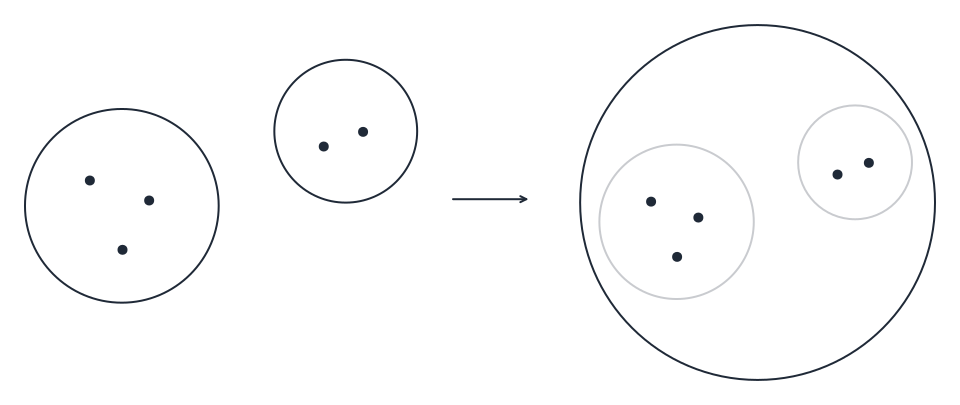
The configuration space of points in $\mathbb{R}^n$ $$ \bigsqcup_{i\geq 0}\operatorname{Conf}_i(\mathbb{R}^n) $$ gives an important example of an $\mathbb E_n$-monoid (in fact, the free $\mathbb E_n$-monoid generated by one element).
The following picture shows one particular multiplication of two elements in the free $\mathbb E_2$-monoid.
Duals and adjoints
The category $\mathsf{Tang}_k^{\mathbb{R}^n}$ has duals for all objects and adjoints for all $i$-morphisms $(i < k)$. (A $k$-morphism in a $k$-category cannot have adjoints unless it is invertible.)
The dual of an object just inverts its $+ / -$ signs.
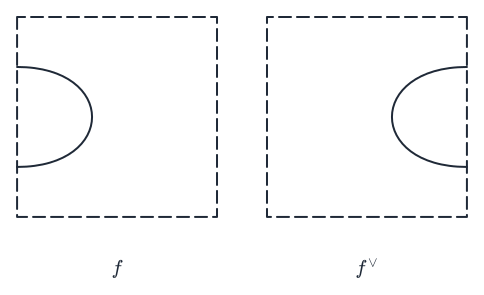
The folloing picture shows a $1$-morphism $f\colon {\ast\ast}\to\varnothing$ in $\mathsf{Tang}_2^{\mathbb{R}^1}$ and its adjoint $f^\vee\colon \varnothing\to{\ast\ast}$.
The next picture shows the counit $f^{\vee}f\to\mathrm{id}_{\ast\ast}$.
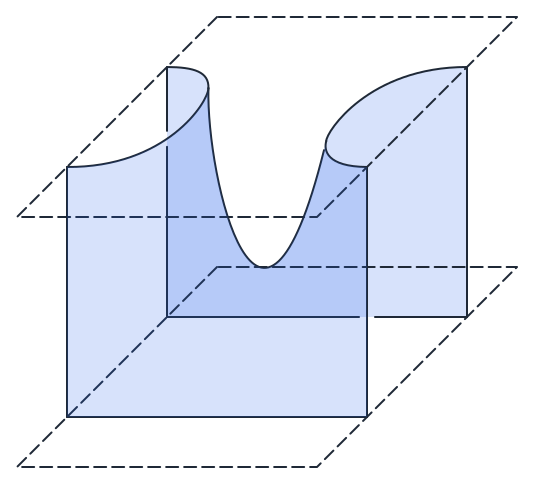
In a similar way we can construct the adjoint for any $i$-morphism $(i < k)$ by reflecting it across the boundary on one side. The unit (counit) is obtained by gradually removing the middle part of the composition $ff^\vee$ ($f^\vee f$).
Statement of the Tangle Hypothesis
Let $\mathcal C$ be an $\mathbb E_n$-monoidal $k$-category with duals. The Tangle Hypothesis states that any object $x$ in $\mathcal C$ determines a unique $\mathbb E_n$-monoidal functor $$ \mathsf{Tang}_k^{\mathbb R^n} \to \mathcal C $$ sending the point $*\in\mathbb{R}^n$ to $x$. In other words, $\mathsf{Tang}_k^{\mathbb{R}^n}$ is the free rigid $\mathbb E_n$-monoidal category generated by one object.
Note an interesting special case $k=0$. A $0$-category is just a space, and $\mathsf{Tang}_0^{\mathbb E_n}$ is just the free $\mathbb E_n$-monoid generated by one element.
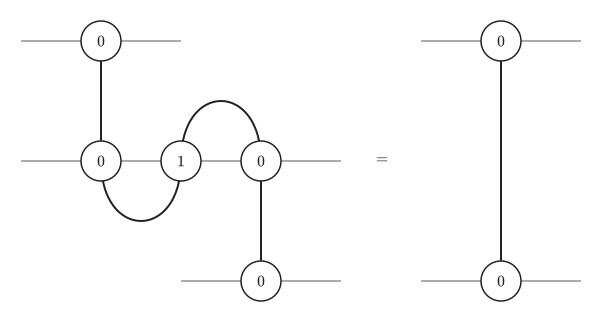
The case $k=1$ deserves some special explanation. We have not defined the framing carefully, but under the correct definition, an object of $\mathsf{Tang}_1^{\mathbb{R}^1}$ is a finite set of points on $\mathbb{R}^1$, each labeled with an integer. The point with label $0$ has a left dual $(-1)$ and a right dual $(+1)$ (see the picture below), and the left and right duals are not the same.
The category of (co)bordisms
The category of (co)bordisms $\mathsf{Bord}_k$ is a symmetric monoidal $k$-category.
- An object $X$ of $\mathsf{Bord}_k$ is a framed compact $0$-manifold (where framing means a choice of a $+ / -$ sign for each point).
- A $1$-morphism $f\colon X\to Y$ is a framed $1$-manifold $M$ with $\partial M = \overline{X} \sqcup Y$.
- For $i\leq k$, an $i$-morphism between $(i-1)$-morphisms is a framed $i$-manifold with prescribed boundary.
This category is very much like $\mathsf{Tang}_k^V$, but objects and morphisms are not embedded into any ambient space. Intuitively, one may think of $\mathsf{Bord}_k$ as $\mathsf{Tang}_k^{\mathbb{R}^\infty}$.
Fact. For a fixed compact manifold with boundary $M$, the space of embeddings $M\to\mathbb{R}^\infty$ is contractible.
When the ambient dimension $n$ tends to infinity, an embedded submanifold in $\mathbb{R}^n$ just becomes a manifold.
Fact. The category of (co)bordisms is a kind of limit of categories of tangles when the ambient dimension tends to infinity: $$ \operatorname{colim}_{n\to\infty}\mathsf{Tang}_k^{\mathbb{R}^n} = \mathsf{Bord}_k. $$
The Cobordism Hypothesis
Let $\mathcal C$ be a symmetric monoidal $k$-category with duals. The Cobordism Hypothesis states that any object $x$ in $\mathcal C$ determines a unique symmetric monoidal functor $$ \mathsf{Bord}_k \to \mathcal C $$ sending the point $*$ to $x$.
Therefore, the Cobordism Hypothesis is a corollary (the limiting case) of the Tangle Hypothesis.
Ribbon categories
A ribbon category is a rigid $\mathbb E_2$-monoidal category with some extra structures.